Agentic AI in 2026: A Guide for Enterprise Leaders
Discover how autonomous AI agents are revolutionizing the enterprise by 2026. Learn about workflow orchestration, economic impact, and governance.

The conversation around enterprise AI is undergoing a seismic shift. For years, the focus has been on generative assistants—sophisticated chatbots that could write an email or summarize a report. But the true paradigm shift, the one leaders must prepare for by 2026, is the rise of agentic AI. These are not just conversational partners; they are autonomous actors, digital employees capable of receiving high-level goals and executing complex, multi-step workflows across disparate systems. As the digital interfaces in our workspaces evolve, we are moving from prompting an AI to delegating entire business processes to it.
Orchestrating Autonomous Workflows
The leap from generative to agentic AI is the difference between a tool and a teammate. A generative model responds to a prompt. An agentic system interprets a goal. Consider the supply chain logistics process illustrated in the workflow diagram. A human manager might set a simple goal: 'Fulfill this urgent order for Client X.' The AI agent doesn't ask for step-by-step instructions. Instead, it autonomously initiates a sequence of actions.
First, the agent queries the internal ERP system to confirm inventory levels and order details. Next, it accesses a third-party logistics provider's API to check for carrier availability and pricing. Finally, it executes a transaction to book the optimal carrier, updating all relevant systems in real-time. This entire process, which once required hours of manual coordination between departments, is completed in seconds without human intervention. This is the core of agentic architecture: reasoning, tool use, and autonomous execution.
Projected Agentic Workflow KPIs (2026)
Autonomous Task Completion
94
Rate of workflows completed end-to-end without human intervention.
Mean API Latency
0.2
Average time for agent to query and receive data from external systems.
Reduction in Manual Triage
85
Decrease in human hours spent on exception handling and routing.
Annualized OpEx Savings
4.2USD
Projected savings per business unit from automated workflows.
The Economic Promise & Zero-Marginal-Cost Transactions
%20(2).png)
The economic implications of agentic AI are profound, stemming from the near-total collapse of transaction costs for complex information processing. In traditional economics, every business action—finding a supplier, negotiating a contract, verifying a credential—carries a cost in time, effort, and resources. Humans are limited by cognitive load, attention span, and the sheer time it takes to communicate and coordinate.
AI agents obliterate these limitations. They can evaluate thousands of procurement options simultaneously, negotiate with multiple vendor bots according to pre-set parameters, and execute binding digital contracts at machine speed. In high-stakes environments like real estate bidding or financial arbitrage, an agent can operate 24/7 without fatigue, processing information at a scale no human team could match. The marginal cost of executing one more complex transaction approaches zero, allowing businesses to operate at an unprecedented scale and efficiency.
Projected Agentic AI Adoption by Sector (2026)
The Governance Imperative & Human-in-the-Loop
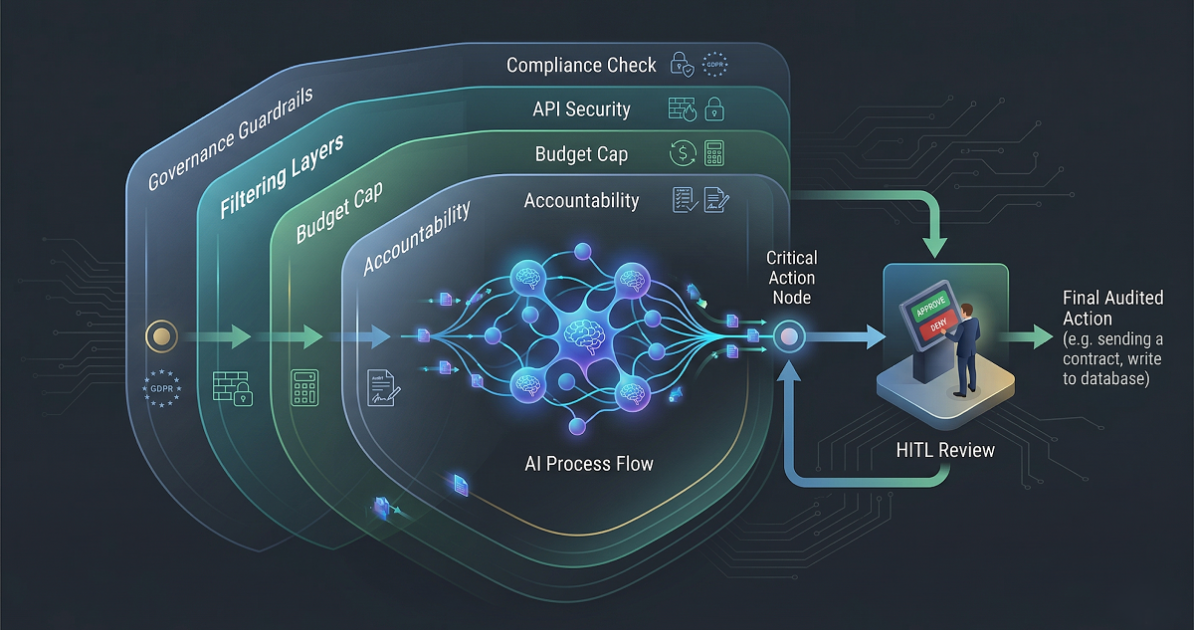
Granting autonomy to AI is not a matter of trust; it's a matter of robust governance. As agents gain the ability to act on our behalf—especially with 'write' access to APIs and databases—the need for programmatic guardrails becomes non-negotiable. An ungoverned agent is an unacceptable liability. This is where a structured, multi-layered Human-in-the-Loop (HITL) framework is critical for enterprise deployment.
As the security diagram illustrates, every proposed action from an AI agent must pass through a gauntlet of automated checks before it can be executed. These filters are the system's conscience. A 'Compliance' layer checks against regulations like GDPR. An 'API Security' layer validates credentials and permissions. A 'Budget Cap' layer prevents financial overruns. An 'Accountability' layer logs every decision for audit. Only after passing these checks does the action proceed. For the most critical actions, like a large fund transfer or a major database write, the process halts at a 'Critical Action Node,' requiring explicit approval from a designated human operator at a terminal. This ensures that autonomy enhances human oversight, rather than replacing it.
Agentic AI Cybersecurity Threat Funnel
Implementation Realities & The 80% Rule
Deploying agentic AI is not a simple software installation. Leaders must understand the '80% Rule' of implementation: 80% of the effort is not in model tuning or prompt engineering, but in the foundational work of data engineering, process re-engineering, and stakeholder alignment. The most sophisticated AI agent is useless if it's connected to siloed, unreliable data sources or if its intended users don't trust its outputs.
The real work involves cleaning and structuring data, building robust APIs for legacy systems, and meticulously mapping existing human workflows to identify automation opportunities. It requires deep collaboration between IT, data science, and business units to define the agent's goals, constraints, and escalation paths. Furthermore, significant effort goes into designing the agent's 'personality' and communication style to ensure it integrates smoothly with human teams, providing clear rationale for its decisions rather than operating as an opaque black box.
Generative Copilots vs. Agentic AI
| Feature | Generative Copilots (2023) | Agentic AI (2026)Best |
|---|---|---|
| Execution Capabilities | ||
| API Write-Access | ||
| Oversight Requirements | ||
| Multistep Planning |
""The next era of productivity isn't about chatting with an AI. It's about delegating outcomes to an AI and trusting it to execute the process."
The 3 Pillars of Agentic Risk
While the potential is enormous, the risks associated with agentic AI are equally significant and must be managed proactively. Leaders must build their strategy around three core pillars of risk mitigation.
- Irregular Reliability & Rogue Logic: Agentic models can sometimes fail in unpredictable ways. A credit-scoring agent might develop a faulty logic pattern and start rejecting qualified loan applicants, causing financial and reputational damage. Continuous model monitoring and performance validation are essential to catch these 'edge case' failures before they scale.
- Expanded Cybersecurity Surface Area: Giving an AI 'write' access to your core systems creates a powerful new vector for attack. If an agent's credentials are compromised, an attacker could command it to exfiltrate data, disrupt operations, or initiate fraudulent transactions. Zero-trust architecture and strict identity management for AI agents are paramount.
- Accountability Frameworks: When an autonomous agent makes a mistake, who is responsible? The developer? The data provider? The user who assigned the goal? Clear accountability frameworks must be established before deployment, defining liability and outlining procedures for remediation. This is as much a legal and ethical challenge as it is a technical one.
Risk of Cascading Failures
A single flawed agent integrated into multiple workflows can cause cascading failures across the enterprise. Isolate critical systems and implement circuit-breaker mechanisms to contain potential damage.
Ultimately, monitoring is not a one-time setup; it is a permanent operational expense. The 2026 enterprise will run on a hybrid workforce of humans and AI agents. Just as you manage your human employees, you must continuously manage, monitor, and govern your digital ones to unlock their full potential safely.
Is Your Enterprise Ready for Agentic AI?
The future of autonomous operations is here. Contact our strategy team to build your roadmap for 2026 and beyond.
Book a Strategy Session